Showing posts with label Saints' Lives. Show all posts

Thursday, 20 April 2017

Do You Know the Way to St Tropez?

I recently saw a poster of Brigitte Bardot in the 1957 movie Et Dieu Créa La Femme (And God Created Woman). Besides presenting la Bardot, the film launched the town of St Tropez, which had not until then made the impact on tourists that Cannes had already for a century.

I was surprised to see that, even today, sixty years on, St Tropez has fewer than 6,000 inhabitants and has never been connected to SNCF railways. Clearly part of its exclusivity was that it was hard to reach.

I came then to wonder who this saint was. ‘Tropez’ is hardly a common name. He may have been a Roman, with a name given as ‘Caius Silvius Torpetius’, a martyr executed, it is said, by Nero on 29 April AD68. His martyrdom is connected with the port of Pisa. Pisa is held to be an Etruscan city, since it contains an Etruscan mausoleum, so ‘Caius’ would be Gaius, most common Roman praenomen; Etruscan has no letter G. Silvius, the nomen of the Gens Silvia, tells us little either. This was the name of the royal family of Alba Longa, but not one in existence in later times.

Torpetius is a useless cognomen, as it means nothing in Latin. I speculate that is might be a local pronunciation in P Italic of the same word which in Latin is Torquatus. This would tie us in to some very important people.  Two shared the name Lucius Junius Silanus Torquatus. The elder, uncle to the younger, was praetor in AD48, but committed suicide on 1 January 49, having been accused by Claudius of incest with his sister. The nephew, descended from Augustus, was exiled as soon as Nero acceded to the throne and sent ‘to a country town’ where he died. Could this be Portus Pisanum?

The saint was supposedly either a gladiator or a member of the emperor’s personal guard. Well, it’s highly unlikely that he would be both a gladiator and have the Roman tria nomina. Roman citizens were forbidden to be gladiators and gladiators were denied the right ever to become Roman citizens. So we can scotch that.

It’s also highly unlikely that at that time an ordinary soldier in the imperial bodyguard would be a Roman citizen, not while serving anyway. The imperial bodyguard mostly comprised Germans. However, senior officers of the bodyguard would probably be equites, another relationship mentioned by saints’ lives of Torpetius.

Orthodox Christian Image of St Torpetius
The saint was beheaded and then placed in a boat with a cock and a dog, and sent down the River Arno to the sea, where, mirabile dictu, it floated all the way to southern Gaul. There are also claims that it drifted to Spain and even Portugal.

The boat with a cock and a dog, which, according to the miracula, didn’t touch the saint’s body but instead ran off once the boat landed in Gaul and had villages named after them, does strongly resemble the Roman punishment of poena cullei, in which the condemned man, often a parricide, was placed into a leather bag with snakes, a cock and a dog, who would injure him in their panic as all floated down the river (usually the Tiber) to certain death. The punishment was so peculiar that it was dreaded, and while it dated back to the Republic, it was used heavily by Claudius and Nero, was revived by Constantine and was still used in the era of Justinian.

So I suggest that St Tropez, Tropes in Provençal and Silvius Torpetius in local Latin, may have been Silanus Torquatus, killed by Nero for reasons unconnected to any supposed connection to early Christianity. Decapitation was not a normal Roman punishment, but one used by the Gauls (and Britons) to get rid of their political enemies. In the Christian era, pagan statue heads, like that of Apollo at Uley in Gloucestershire, might be buried as a damnatio memoriae.

If the fishermen of the unnamed Gaulish village had received a headless body in a boat, even with a cock and a dog, they would not have known it was a saint, would they? Tropez has no in vivo miracles attached to him. His vita, the Passio Sancti Torpetii, dates from the ninth century, which takes us very much into the Carolingian period, when this part of France was occupied by Arab Muslims. Subverting their tolerant regime by instigating and promoting a saint’s cult smack in the middle would be a typical piece of cultural theatre for the middle ages.

The priests who invented the saint also created a holy woman called Celerina, who had had a vision of the arrival of St Tropez, and who retrieved his body and dealt with it. Assuming this to be a Christian figure, it would be anachronistic, since there were almost certainly no Christians in Gaul at that time. Her name is a female version of Celerinus, considered a saint and ‘martyred’ by the emperor Decius at Carthage in AD250. He died of natural causes so he ought to be a confessor rather than a martyr, in that he was willing to be martyred, but wasn’t. He did have an aunt called Clerina who was a martyr, so maybe she is the Celerina in question, a mere 200 years later. Again, the Church would look for kudos for France based on this early martyrdom and an early saint. Many Gaulish female saints are Christianised versions of pagan goddesses anyway.

One source of the myth may have arrived from Spain. Liutprand of Cremona, the notoriously bad-tempered priest who worked for the Emperor Otto I and who rubbished Byzantium, recorded that Muslim converts called Muwallad, Latin speakers, landed at St Tropez (Heraclea was its ancient name) in 889 and rebuilt Fraxinet, anciently Fraxinetum, making it an important settlement. They were expelled by the forces of Count William, Margrave of Provence, because they had kidnapped the Abbot of Cluny. Losing the Battle of Tourtour in AD973, the Andalusis were killed or enslaved, and this marked the point at which all local and immigrant Muslims left that area of Francia.

Inventing a major saint, one with a Roman pedigree and international appreciation, is exactly what rulers did to win control of territories.

Les Bravades de St-Topez, Catholic Ritual in France
If Torquatus is the Torpetius/ Tropez of the martyrologies, he was unlucky to die on 29 April, in that Nero committed suicide on 9 June AD68, just a few weeks later.  Maybe he was merely exiled by Nero, since there is little to be gained in exiling someone just to kill them. If you’re emperor, you just kill them. If, as is suggested, Torquatus was a relative, Nero exiled him, and it was Galba who had him killed. By 29 April, the army revolt against Nero was in full spate.  The emperor was too busy trying to persuade his bodyguards not to run away and leave him to his fate (described by Tacitus Histories and Suetonius Twelve Caesars) to worry about early Christians (the claim that Nero executed SS Peter and Paul dates to Lactantius On the Death of the Persecutors (Chapter 2) in the early fourth century; earlier claims had been that they were executed during his reign, but not at his command).

Rococo image of the martyrdom of St Tropez
In summary, I consider that Saint Tropez was invented out of scraps of ancient texts  about Silanus Torquatus, with a dash of Lactantius and a pinch of grand guignol for the counts of Provence, to use as a justification to expell the hard-working and popular Muslims from the Fraxinet-Heraclea.

We’ve come a long way from Brigitte Bardot, but her life has at least been less fictionalised than St Tropez himself.


Sunday, 11 September 2016

Tales of the Riverbank: Severinus and Rome's Fall

The very edge of the Roman Empire; the people are being pushed out or taken captive by invaders; the remaining soldiers are fading away; a hero is needed to lead the people to fight back and win. A man appears as if from nowhere and does just that.

Does that sound a bit like King Arthur? Quite a bit, I’d say. But this was not post-Roman Britain, but almost-post-Roman Austria. This border was not Hadrian’s Wall, but the river Danube. And the hero was not Arthur, but Severinus, a mysterious holy man, later regarded as a saint.

We have a detailed biography of him by Eugippius, a monk who knew him well, the Vita Sancti Severini (henceforth just Vita), together with a letter from Eugippius to a deacon called Paschasius in AD511, and Paschasius’ reply. There is also a reference to Severinus and some of the events of that time in the work now known as the Anonymous Valesianus and the Vita Sancti Antonii Eremitici, a Life of St Antony the Hermit, who had lived and worked alongside Severinus. Severinus also features in the History of the Lombards by Paul the Deacon, a Lombard contemporary of Charlemagne. There is also a modern discussion in Bryan Ward-Perkins’ The Fall of Rome and the End of Civilisation (OUP, 2005).

Saints’ Lives were the principal form of literature in Europe and the Near East in late Antiquity. They were written for a growing monastic readership. The Rule of St Benedict requires a young monk with a good voice to read improving literature to the monks at dinner time (Rule, Ch.38) Benedict’s Rule was written at Monte Cassino between 528 and 543. Saints’ Lives that already existed were ready made for Chapter 38.

Severinus appeared, as if from nowhere in the 450s, to minister and run the towns along the south bank of the Danube in the Roman province of Noricum Ripense in what is now the panhandle of western Austria.

Austrian schilling coin of 1982 depicting St Severinus

What we witness through the Vita is the disintegration of a province in the middle of the fifth century. And Noricum Ripense was part of the prefecture of Italy, close enough to make the Italians notice. Yet it turns on many dubious points.

The appearance of Severinus at just the right time reminds me of nothing more that the role of The Stranger played by Clint Eastwood in my favourite western High Plains Drifter (1973); if Eugippius had not known him personally (a standard trope of vitae is personal attestation that however clichéd the miracles are, they really happened), you would consider it more like a classical myth.

The Noricans played little part in defending their own province. Local place names reflect this: Batavis (modern Passau), Asturis, Commagenis. These reflect the places established alongside the Danube by and for soldiers recruited from the Batavi (in the Netherlands), the Asturians (in north west Spain) and the men of Commagene (possibly Isaurians) in Asia Minor. These were clearly military forts.


It is hard to know where the ‘barbarians’ were located. At Commagenis they were within the walled town as protectors, and rushed out when an earthquake struck (Vita 2); in other locations they were invaders.

And who exactly were the locals? When Noricum asked to join the Roman Empire, what is now southern Germany was part of the Celtic world.  We can tell by the detailed place names given by Ptolemy’s Tetrabiblios map data, which are full of names ending in the classic Gaulish –acum and -dunum (Lacus Curtius has modern renditions of these maps). So the area north of the Danube was not yet Germanic in c.150. The names of Batavis and other places suggests that auxiliaries were settled upon discharge near where they had served. Only Lauriacum, with its Gaulish name (modern Lorch)  seems to have been a metropolis for the remaining Noricans.

Noricum was well known for its iron mines, which are mentioned in Rutilius Namantianus De Reditu Suo, book 1, where they are compared with those of Elba and Sardinia. Perhaps that was what made the area desirable for the Germanic peoples (had they worked as guards there?) and worth the Romans defending. Legion II Italica Pia was established in Lauriacum by Marcus Aurelius in c.180, and these may be the few who remained to defend Noricum in the fifth century. The Vita contains this moving account of the last soldiers:

So long as the Roman dominion lasted, soldiers were maintained in many towns at the public expense to guard the boundary wall. When this custom ceased, the squadrons of soldiers and the boundary wall were blotted out together. The troop at Batavis, however, held out. Some soldiers of this troop had gone to Italy to fetch the final pay to their comrades, and no one knew that the barbarians had slain them on the way. One day, as Saint Severinus was reading in his cell, he suddenly closed the book and began to sigh greatly and to weep. He ordered the bystanders to run out with haste to the river, which he declared was in that hour besprinkled with human blood; and straightway word was brought that the bodies of the soldiers mentioned above had been brought to land by the current of the river. (Vita Ch.20)

The border wall was the Roman limites, which ran from the North Sea to the Black Sea. Around Lauricum, the system switches from the Upper Germanic limes to the Raetian limes. Was there a weakness either in physical structure or in the chain of command, as might have been known by some Germanic peoples who had served with the Roman army? 

Reconstruction of the Danubian limes, 19th century
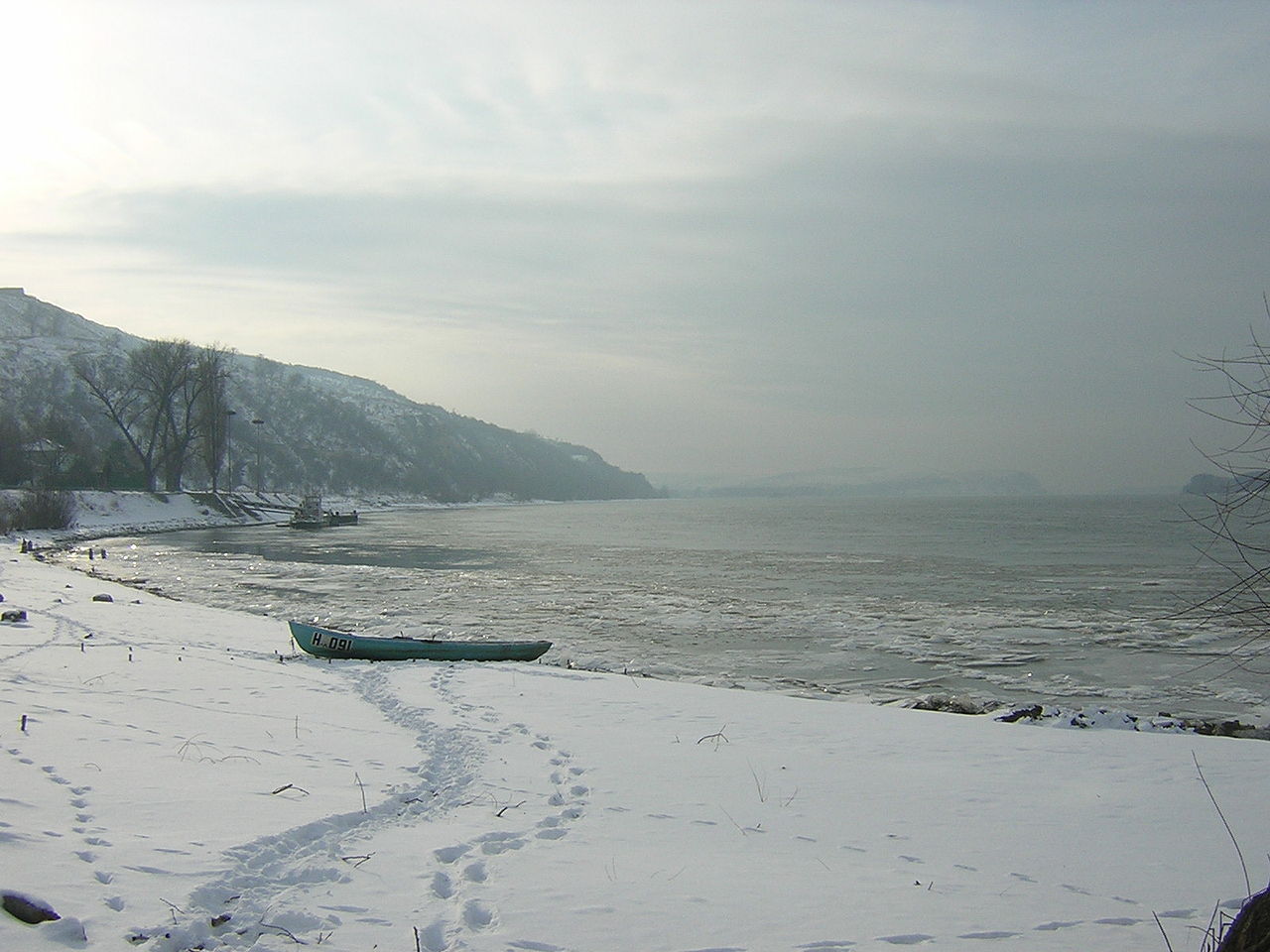
Eugippius tells us about the frozen Danube affording movement of people: ‘A well-known proof of the terrible cold is afforded by the Danube, which is often so solidly frozen by the fierce frost that it affords a secure crossing even for carts’ (Vita 4). This matches the comment of Jordanes that the Danube ‘freezes so hard that it will support like a solid rock an army of infantry, and carts and sleds’ (Getica 55). I suspect that this is the origin of the story often told as if fact about the barbarian invasion of New Year’s Eve 406 crossing the frozen Rhine near Strasbourg. The Danube froze at Vienna in January 1901 according to Eugippius’s translator in 1914. Our source for the crossing of the Rhine on that date is Prosper Tiro of Aquitaine, whose detailed Chronicle does not mention it being frozen then. It may be as late as Gibbon, but what Gibbon took as a surmise (‘On the last day of the year, in a season when the waters of the Rhine were most probably frozen, they entered without opposition the defenceless provinces of Gaul.’ Ch.30) has been relayed as a fact by later historians.

A comment is also made by Herodian that ‘The Rhine in Germany and the Danube in Pannonia are the largest of the northern rivers. In summer their depth and width make them easily navigable, but in the cold winters they freeze over and appear like a level plain which can be crossed on horseback. The river becomes so firm and solid in that season that it supports horses and men’ (Herodian Roman History 6.7); this is a description of a battle by Maximinus Thrax at Sirmium in AD236.

An icebound Danube also features in references to a famine at the town of Favianis. However it seems that the cause of the famine was a local magnate ‘a certain widow, Procula by name, had concealed much produce of the fields’ (Vita 3). Severinus is said to have publicly berated her for hoarding the corn, presumably for power and profit. By forcing her to release her store, Severinus ended the famine.

Not long after, there unexpectedly appeared at the bank of the Danube a vast number of boats from the Raetias, laden with great quantities of merchandise, which had been hindered for many days by the thick ice of the river Aenus. When at last God's command had loosed the ice, they brought down an abundance of food to the famine-stricken. Then all began to praise God with uninterrupted devotion, as the bestower of unhoped relief; for they had expected to perish, wasted by the long famine, and they acknowledged that manifestly the boats had come out of due season, loosed from the ice and frost by the prayers of the servant of God (Vita 3).

This was coming from Raetia (Switzerland) and had floated downstream, but been blocked off by ice floes from the river Aenus (the Inn, as in Innsbruck). This does show that the movement of food and supplies continued. How this had happened is hard to tell, but it looks more like commerce than the prayers of the stricken. Later we read of oil reaching Noricum Ripense ‘a commodity which in those places was brought to market only after a most difficult transport by traders’ (Vita 28). One of his acolytes, Maximus, arranged for a collection of donated clothes to be transported 200 miles across the Alps in winter to the Danube, having hired local men to fetch it on their backs (Vita 29), allegedly guided by a non-hibernating bear. Timing is all; the icebound river presumably prevented fishing, which would normally have prevented famine.

The frozen Danube in a recent picture
The Vita contains several elements found elsewhere in later hagiography. The enemy are always furious, always angry with the Romans and always keen on killing them. The enemy are implicated here in the death of the two soldiers mentioned above. Likewise two men are captured by the enemy less than two miles from the city walls of Favianis, having been warned off from going to collect fruit from the orchards (Vita 20). Similarly, we are told that ‘Hunimund, accompanied by a few barbarians, attacked the town of Batavis, as the saint had foretold, and, while almost all the inhabitants were occupied in the harvest, put to death forty men of the town who had remained for a guard’ (Vita 22).

Later we are told that the Heruli attacked Ioviaco (Salzburg) ‘That night the Heruli made a sudden, unexpected onslaught, sacked the town, and led most of the people into captivity. They hanged the priest Maximianus on a cross’ (Vita 24). The ‘enemy’ also sought to scale the walls of Lauriacum, but because nearly all livestock had been herded within the walls seized cattle left outside and went away, abandoning their scaling ladders (Vita 30).

There seems to be a considerable confusion just who the inhabitants of Noricum Ripense were facing. They seem to have the Heruli, the Alamanni, the Rugii and the Thuringi attacking them at different times. The saint’s response seems to have been to abandon the towns after a little resistance. It is worth quoting in full Chapter 27:

At the same time the inhabitants of the town of Quintanis, exhausted by the incessant incursions of the Alamanni, left their own abodes and removed to the town of Batavis. But their place of refuge did not remain hidden from the Alamanni: wherefore the barbarians were the more inflamed, believing that they might pillage the peoples of two towns in one attack. But Saint Severinus applied himself vigorously to prayer, and encouraged the Romans in manifold ways by examples of salvation. He foretold that the present foes should indeed by God's aid be overcome; but that after the victory those who despised his admonitions should perish. Therefore the Romans in a body, strengthened by the prediction of the saint, and in the hope of the promised victory, drew up against the Alamanni in order of battle, fortified less with material arms than by the prayers of the saint. The Alamanni were overthrown in the conflict and fled. The man of God addressed the victors as follows. "Children, do not attribute the glory of the present conflict to your own strength. Know that ye are now set free through the protection of God to the end that ye may depart hence within a little space of time, granted you as a kind of armistice. So gather together and go down with me to the town of Lauriacum." The man of God impressed these things upon them from the fullness of his piety. But when the people of Batavis hesitated to leave their native soil, he added, "Although that town also, whither we go, must be abandoned as speedily as possible before the inrushing barbarism, yet let us now in like manner depart from this place."

As he impressed such things upon their minds, most of the people followed him. A few indeed proved stubborn, nor did the scorners escape the hostile sword. For that same week the Thuringi stormed the town; and of those who notwithstanding the prohibition of the man of God remained there, a part were butchered, the rest led off into captivity and made to pay the penalty for their scorn.

In short, the people of Quintanis moved to Batavis, and when that was sacked, they went to Lauriacum, with a view to a withdrawal to Italy. Both the Alamanni and Thuringi were involved at different times.

Noricum Ripense was, as mentioned above part of the Prefecture of Italy. The Prefect at that time seems to have been Caecina Decius Basilius, a high born Italian noble, who later was made Consul and who had three sons who also made both Prefect and Consul under Odoacer. His sole objective seems to have been to suck up to whoever was ruler at the time. He clearly failed to maintain adequate communication with the Danube. The last Prefect before Odoacer was Felix Himelco, a man one assumes of Punic ancestry.

Relations with Germanic neighbours was not always bad, as Chapter 14 tells us how Gibuldus the local king of the Alamanni came secretly to Batavis and negotiated with Severinus and arranged for many prisoners to be freed and returned home. Interestingly, Amantius, a local priest, sent letters to Gibuldus and received several from him, suggesting either the king was literate or had staff who were. Perhaps the king was a former Roman soldier.

One of the groups most closely involved with Noricum were the Rugii. They had once lived on the Baltic island of Rugen, but had morphed into a warband, which means they were probably around 150 strong. Now 150 armed men can do a lot of damage, but they are not the overwhelming numbers people often talk about. This is Dunbar’s Number, the maximum number of people one individualcan know properly, and thus command. The Roman First Century of the primus pilus had a full strength of 160. As mentioned above, in Commagenis, the Germans were local defenders, while at Batavis, they were few enough in numbers to catch local men in orchards Sometimes, even in winter, it was safe enough to transport supplies down the Danube despite ice. The toughest of all warriors was General Winter.

In some instances the Rugii were voluntarily protecting the Romans against fellow Germans. Feba, the Rugian leader, probably a kinsman of King Odoacer, offered to protect the locals and this was accepted (Vita 31).

We have some clue to who Severinus was. When he died in AD482, he was conveyed to Naples, where a rich woman called Barbaria built a mausoleum for him in a castle. She had corresponded with Severinus, which suggests a postal service of some sort still existed. This suggests that Barbaria was some form of kinswoman (Vita 46).

Severinus is credited both in the Vita and the Anonymous Valesianus with having met Odoacer long before he became king of Italy and, like all good saints to have predicted Odoacer’s rule. After Severinus’ death, the Rugii seem to have fallen into a disputed succession between Feba’s brother and his son and for attacks on the Roman towns, which required Odoacer to send in a full army, and then, via his brother Onoulph, also a Roman general, and a comes called Pierus, to order the evacuation of all remaining Romans to Italy (Vita 44).

Those who would prefer to see the end of the Roman empire as the peaceful accommodation of a handful of almost-Roman soldiers will be disappointed. The terminology in French and German is educational: Les invasions barbares versus die Völkerwanderungen (wanderings of the people). Germans might easily be on all sides of what clearly could be a major struggle and people who considered themselves Roman could either settle down under new masters or be evacuated to Italy. Either way, nothing remained quite the same.


Monday, 18 July 2016

Gender Bending in the Late Empire and Beyond

Sexual dysphoria in late antiquity, which I discussed in my posting on Ausonius, can be found in other instances.

There is a Vita, a saint’s life, for St Matrona, a woman who gave up a typical life in the eastern empire in the fifth century to become a monk, rather than a nun, disguised her sex and took a male name, Babylas. She seems to have been born c.AD410. Her name is suspect (Matrona just means ‘married woman’ in Latin). However she is historical, was visited by the wife of the Emperor Leo and the wife of Anthemius, dating her to the 460s, and her reasons for adopting male identity are rational. She came from Perga in Pamphylia, on the south coast of Asia Minor. ‘Babylas’ is the name of a famous third century bishop, martyred in Syria, and whose church was built to block the temple of Apollo at Daphne, near Antioch.

Here’s a selection from the Vita.

Again, as Matrona was seeking to learn how she must live in quietude (and) to please God, she was taught by the Lord through a vision in her sleep. Hers was a marvellous one. It seemed that her husband was chasing her and, as she fled, she was saved by some monks, which signified that she must go in a monastery of men and enter into the life of monks. For in this way, she would not be recognized either by her husband or by others.

She shaved her hair close to the skin and dressed herself like a eunuch. [That is to say that she put on men's clothes]. Once more she went with Eugenia to the said Church of the Holy Apostles, and desiring to learn the meaning of secret things from the divine, she opened the Holy Bible, and there she found it stated: "He who wishes to come after me, let him deny himself, and take his cross, and follow me." [Lk. IX. 23). Thereupon, they had a firm knowledge of the things that please God, and having abandoned themselves to Him and expecting Him to be their assistant in their practices, they parted from each other.

Matrona, as has already been said, pretended to be a eunuch, and called herself Babylas. She went to the monastery of the holy Basianus. There she was received by the monks and immediately engaged in spiritual competition. She did not feign devotion by sadness and paleness of her face rather, she was truthfully pursuing virtue and was eager to escape notice, so that she soon elevated herself to the perfect life according to God, and all marvelled that a man afflicted with the weakness of a eunuch could so endure hard labors and seek to surpass all the monks, winning over the spirit and despising glory as vanity and being completely obedient out of great modesty (From Ch.6).

It happened that once she was working in the garden with other monks, (and) she was more zealous than they in her work. A monk by the name of Barnabas, who was assigned to work with her, looked at her curiously. He had entered the monastic life a short while earlier, (and) even though he had come from the stage later he increased in virtue and became a hegumen [abbot]. He asked her to tell him why the lobes of her ears were pierced. The blessed woman quickly gave him an intelligent answer saying, "You have, O brother, suffered something human which is alien to our profession. One must pay attention to the land and not gaze curiously on human features. But to answer your question: the woman who had owned me before and who raised me was so affectionately disposed toward me that she wished even to place gold ornaments in my ears." So, the blessed woman, wisely, rid the monk of his suspicions.

But many troublesome thoughts came to her, and she remembered the exhortation of Eugenia who said: "it is difficult for a woman to live with men and pretend to be a man. It is impossible to avoid detection forever." (From Ch.7)

A similar life was lived by Theodora of Alexandria, wife of a Prefect of Egypt, who left her husband and lived as a man in a monastery, only being discovered as a woman after her death. During her time as a man she must have been tonsured and acted in a masculine way never to have been discovered. She was accused of fathering a child with a local woman. She had become a monk supposedly in penance for a sin; the logic of this is that she may have had a lesbian experience and punished herself by placing herself among only men as a man, a symbolic removal of self from sex.

There are also vitae of ‘desert mothers’ such as St Pelagia and St Marina ‘the monk’, who may be the same person, because their names have identical meanings in Greek and Latin. Certainly St Marina of Syria seems a bit late (her death is given as AD750) since Syria had been under Islamic rule for 110 years. St Pelagia lived as Pelagius, so it may have involved some transfer from the British heterodox theologian of that name, whose followers in fifth century Britain were known for their flamboyant clothes. By contrast, there is a late imperial princess Marina, sister of the Emperor Theodosius II, born in AD401 and possibly his non-identical twin. She gave her name to the Marina Quarter of Constantinople and was known for her piety, following the example of her elder sister and imperial regent, Pulcheria.

Marinus/Pelagius was so much into the role of being a man, she accepted responsibility for impregnating a local girl and acted as a father to her baby. It was only after her death that the women charged with washing her body discovered the truth. This transgender saint is venerated by the Maronite church and by the local Roman Catholic church, refounded in AD751, a year after Marina’s supposed death, suggesting that there was a power struggle in the Church at that time, each side using her to legitimate their presence in the Muslim-dominated Levant; among a dwindling congregation of dhimmi (non-Muslims allowed to worship freely), a genuine local saint would have been a strong impetus.

Many of the comments refer to the extreme asceticism of the woman living as men, notably how starved they were. All of them may be mythologised versions of St Mary of Egypt, found starving to death in the Egyptian desert dressed in rags that had once been a monk’s habit. Marina is a diminutive of Maria, on whom she may have been modelled.

The second extract, which involves a man living as a woman, is from Gregory of Tours, the sixth century Gallo-Roman metropolitan (archbishop) of that city. If anyone thinks this is a bit late to be Roman, let’s remember that Gregory (born Georgius Florentius) considered he came from a ‘senatorial family’, one that would have held the position of senator if it had still existed (his ancestor Aquilinus had been a noble in Lyon under the empire). Gregory was born in AD538, which makes him contemporary with Justinian and Procopius.

The following event took place at the nunnery in Poitiers (Pictavia) in AD589, in which Basina and Clotild, two Frankish princesses living as nuns, revolted. Gregory was their metropolitan and was called in to adjudicate at a formal tribunal; he reports:

Then the bishops who were present sat on the tribunal of the church, and Chrodield [Clotild] appeared and gave vent to much abuse of the abbess and many charges, asserting that she had a man in the monastery who wore woman's clothes and was treated as a woman although he had been very clearly shown to be a man, and that he was in constant attendance on the abbess herself, and she pointed her finger at him and said: "There he is himself." And when this man had taken the stand before all in woman's clothes, as I have stated, he said that he was impotent and therefore had put these clothes on; but he did not know the abbess except by name and he asserted that had never seen her or spoken with her, as he lived more than forty miles from the city of Poitiers. Then as she had not proved the abbess guilty of this crime, she added: "What holiness is there in this abbess who makes men eunuchs and orders them to live with her as if she were an empress." The abbess, being questioned, replied that she knew nothing of this matter. Meantime when Chrodield had given the name of the man who was a eunuch, Reoval, the chief physician, appeared and said: "This man when he was a child was diseased in the thigh and was so ill that his life was despaired of ; his mother went to the holy Radegunda to request that he should have some attention. But she called me and bade me give what assistance I could. Then I castrated him in the way I had once seen physicians do in Constantinople, and restored the boy in good health to his sorrowing mother’. (Gregory of Tours Decem Libri Historiarum, Bk 10.15)

Here ‘thigh’ seems to be a euphemism for male genitals, as it is believed to be in the birth of Dionysus (who was born from Zeus’s ‘thigh’ and was god of wine, while Athena was born from his head and was goddess of wisdom; you work it out!). We might wonder if ‘diseased in the thigh’ is a physiological condition from malformed or damaged genitals, or a psychological interpretation of homosexuality as a mental illness. Castration here seems to mean total removal of exterior genitals, which it was in the Eastern Roman/Byzantine world in the sixth century. This would have meant the child would have more closely resembled a girl, and could have passed as such for a while. Male castrati in adulthood do not resemble females. According to Georgian descriptions and cartoons, they grew to be very tall and had large chests.

The last narrative I want to discuss here is the strange tale of the Valesians of southern Gaul. This religious sect, originating in the near east, was found in Gaul in the later fourth century AD. It is noted for its extreme attitudes towards sin, which they thought came to men through the genitals and could only be cured through castration. This is discussed in Leadership and Community in Late Antique Gaul by Raymond Van Dam (U Calif Press, 1985, pp.80-1). Despite its dull name, this is an excellent book on the later empire.

This sect was known well to Epiphanius of Salamis who discusses them at length (Panarion 38, pp100-4). Epiphanius was bishop of Constantia on Cyprus. Even he says ‘But these people are really crazy’. They seem to have been Arabs living in what is now northern Iraq and to have broken off during the reign of Aurelian, when this area was under the rule of Palmyra and almost anything went. They seem to have been extreme Sethians, followers of a religion similar to Judaism which regarded Seth, third son of Adam and Eve, as their founder.

Epiphanius reports they were not allowed to eat red meat unless they had been castrated. ‘It is widely rumoured’ he says ‘that they have often made this disposition [forced castration] of strangers when they were passing through and accepted their hospitality. They seize them when they come inside, bind them on their backs to boards and perform the castration by force’. (Panarion 38, 6-7).

A panarion is a Greek medicine-chest, and Epiphanius (AD320-403) wrote the book in c.377. As its name suggests, he treats heresies as diseases, so a mutilation of the body is a medical treatment. He differentiates the Valesians from those born as eunuchs, who he says carry no blame (rather like Gregory’s at Poitiers), and from those made eunuchs by others, such as ‘barbarian’ kings in order to serve in seraglios (somewhat like St Matrona). Epiphanius treated each of the fifty heresies he discusses as animals, and the Valesians he considered to be scorpions.

The difference between the Valesians and the self-castrated priests of Cybele is unclear. Cybele, imported into Rome as ‘Magna Mater’, was a near-eastern goddess, whose priest, Attis, had self-castrated, and all later priests of her cult did, and were allowed to do so in defiance of Roman law, which made it illegal. The Latin term for those priests was galli, literally ‘male-hens’, as galla means hen. The word is a homophone for Galli, men from Gaul (Gallia). This is why the symbol used to this day in France is a cock, and is used in sport (le coq sportif) and the famous crowing bird on the Pathé movie openings.

The great problem for religious groups which oppose sexual contact is that they cannot exist beyond the current generation except by induction of new recruits. This is what did for the Shakers in America and for the higher levels of the Cathars. They depend on junior members who are allowed to marry and on adult converts. The Cathars, as Manichees, survived almost underground from antiquity with ‘hearers’ allowed to reproduce, while the Valesians mentioned by van Dam in Gaul may have been assigned that title by outsiders; they may have been no more than particularly nasty Bacaudae.